Friday, October 26, 2012

A Review of A Year of Biblical Womanhood

The first thing you need to understand, before I say anything else, is this: Rachel Held Evans loves the Bible.

This point is important, because many Christians, upon learning that she is (gasp!) an egalitarian, (shock!) votes Democrat, and (horrors!) supports gay rights, tend to assume that she therefore must not take the Bible very seriously. This impression was only exacerbated when Evans announced some time back that she was going to undertake a "year of biblical womanhood" where, taking a cue from A. J. Jacobs' book, A Year of Living Biblically, she resolved to spend a year living according the Bible's instructions regarding women as literally as possible. Some Christians who do indeed hold to what they call "literal" interpretations of Scripture were convinced that Evans' purpose in undertaking this project was to make fun of them, and even to make "a mockery of God and Scripture" itself (as one of her critics is quoted as saying on p. 285).
Read more »

Labels: , , ,

Monday, December 19, 2011

Reflections on Art and Charles Dickens

Marley's Ghost-John Leech, 1843Shortly before Fuller Seminary closes up for Christmas vacation each December, the staff are treated to an annual Christmas party. This year, while waiting for the munchies to be served, I had the privilege of speaking with Fuller President Richard Mouw for a bit. Among other things, he asked about what books I've been reading, and I was able to tell him that I've been working through the Charles Dickens classic, A Christmas Carol. Perhaps somewhat ironically, although I've seen and heard numerous versions of this story over the years on television, at the movies, and on radio, I've never actually read through the original before, and thanks to the easy access to Public Domain works provided by the Nook, this has seemed a good time to do so.
Read more »

Labels: ,

Friday, July 29, 2011

Angry Conversations with God - A Review

A few weeks ago, I challenged people to consider how "real" their relationship with God was, using an analogy of a person who "loved" Johnny Cash from afar. That illustration helped to show that real relationships have highs and lows. They have "bad" days. Real relationships are hard.

By that standard, Susan E. Isaacs, author of Angry Conversations with God, most definitely has a real relationship with God.
Read more »

Labels: ,

Wednesday, September 29, 2010

Reframing Hope Review

It's no secret that the past few years have been rough ones for many of us.  This is no less true for our churches.  Economic hardship coupled with a rapidly changing world has caused many churches to suffer, and some to even close their doors.  It is into this reality that Reframing Hope is written.

I've written about author Carol Howard Merritt before.  She is one of the co-hosts of God Complex Radio (which, coincidentally, just started a new batch of episodes yesterday) and is the person behind the Tribal Church blog (not to mention the author of the book of the same name).  I've been following Merritt via her blog and her Twitter feed for a few years now, and when she offered a free copy of the book to those of us who agreed to write a blog entry reviewing it, I was happy to take her up on the offer.

Although some people have argued that Merritt is a part of the "emerging church" movement, she prefers to think of herself as a "loyal radical."  "Loyal radicals" are "loyal" because they remain devoted to a particular denominational traditionin Merritt's case, the PC(USA)despite fully acknowledging the imperfections of that tradition, and "radical" because they see the need for, and work toward, change within their tradition.

It is this balance of tradition and change that forms the core of the "hope" that Merritt hopes to "reframe" for us in her book.  Although Merritt's political views may well be considered "liberal" (and she would be the first to admit this), it would be unfair in the extreme to stereotype her too quickly.  She comes from an evangelical background that, while she may no longer claim it as her label of choice today, nonetheless remains a part of her and has valuable contributions for how she views her ministry.  At one point near the end of the book, Merritt writes of two "poles" of US Christian belief: evangelicals and liberals.  As I generally try to claim the "evangelical" label as distinct from "fundamentalist" (and, indeed, as broad enough to include some "liberal" thought), I might quibble with that comment, but not only is Merritt hardly alone in seeing "evangelical" and "fundamentalist" as basically similar, she speaks out of personal experience, and doesn't make this kind of statement lightly.  Indeed, her point in bringing up this polarity is to point out that each side has gifts they can offer the other.

In attempting to describe a way forward for our congregations, Merritt is quick to acknowledge that no one way will work for all.  Each congregation represents a distinct grouping of different types of people, gathered together in a particular place at a particular time.  Taken together, these many "churches" are bound together by a shared Christian tradition (if admittedly over a sometimes broad swath of doctrinal belief within it), but each of these distinct contexts means that each individual congregation faces unique challenges.  Merritt remains fully aware of this while trying to navigate the potentially-tricky waters of providing a kind of map (or, perhaps more accurately, a broad outline) to renewed church vitality.

Merritt does not advocate change simply for its own sake, nor does she disrespect the traditions that many of our congregations have maintained and passed down to us over the years.  There is much of value in these traditions, and we lose them at our peril.  Nonetheless, it is equally an error to refuse to change no matter what happens in the world around us.  Merritt describes, often using stories of actual congregations or actual people, ways in which we might take advantages of new developments in technology and the globalizing world to help the church better respond to the call of God.  This does mean that some congregations who fear these developments may have to learn to push through that fear, but at the same time, discernment is called for:
The possibilities in this new age are fascinating, yet there are dangers that come with the increased use of Internet as a primary form of communication.  As we form relationships and community in our churches, we will have to be sure our care does not become impersonal.  We all know how frustrating it is to call a utility company and spend forty-five minutes on the phone, waiting to speak with a human being.  The company tries to reassure us with soothing Muzak and the hypnotic message, "Your call is very important to us.  Please continue to hold."  But the real message is clear: Your call is not all that important to them.  If it were really important, they would hire more people to answer the phones. (p. 59)
These new developments have real dangers, as well, and we need to be wise in appropriating them.  Technology, by itself, is certainly not the answer, and Merritt makes no suggestion that it is.  Indeed, to the extent that technology draws people away from relationships with each other, or from time spent alone with God, it is being misused and/or abused.  But, to the extent that technology can draw people into deeper relationships with others and with God (and she uses examples from Twitter, Facebook, and the blogosphereamong othersto illustrate how this has been, and might be, done), it can be a valuable tool toward helping us become the kinds of communities of faith God would have us to be.

Merritt also draws attention to the fact that many "new" churches have appropriated "old" traditions and spiritual practices that even more "traditional" churches may have lost.  As God gives us leading (and there's a great bit about the difficulty of discerning whether something is God's voice or our own on page 119), through wise application of these kinds of "traditional" and "emerging" practices, we have reason to hope that the future remains bright for the Christian church.

I definitely recommend your picking the book up, but suggest doing so quickly, as this book is very much tied to its time.  For example, Merritt makes a reference to "the oil disaster in the Gulf of Mexico" (on p. 95) as though it is a current event that her readers will immediately understand, and indeed we do... for now.  BP only announced just a week or so that the well is officially "dead," but of course the clean-up efforts will continue for some time to come. But I imagine that in just a few years, people will read this reference and no longer immediately understand what incident Merritt is referring to. This is a minor concern, of course. The book is worth reading, regardless.

Labels: ,

Wednesday, June 07, 2006

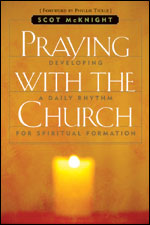
Book Review: Praying with the Church

One of the blogs I read regularly is Jesus Creed, maintained by North Park University professor Scot McKnight. Some time back, his publisher, Paraclete Press, offered to send a copy of his book, Praying with the Church, for free to bloggers, on the condition that they would write a review of the book. The book arrived some time ago, and I was given roughly a month to read through it process my thoughts.

This book is not just about encouraging Christians to pray, or even to pray "more," but rather it is a tool for rediscovering the practice of praying at "fixed hours," and using specific pre-written prayers of importance to the Christian community. This was the common practice of the early church, but today is seen more frequently in the other Abrahamic religions: Judaism and Islam.

The first line of the first chapter spoke to me immediately: "Most Christians are not happy with their prayer life — they either don't pray often enough or well enough." (p. 1) I'm a strong believer in prayer, and do make it a point to pray at meals, when asked by a friend, when witnessing a situation that calls for it, etc. However, I've often felt that my prayers, as frequent and as intentional as they are, are often too shallow. With his first line, Dr. McKnight promised to speak to my concerns.

Now, I grew up in the PC(USA), which appears to have been a more liturgical tradition than Dr. McKnight's own (He comments on not being able to recall reciting the Lord's Prayer during a Sunday worship service . This has always been a part of my tradition.). Still, when he describes people's mistrust of using pre-written prayers, I can readily identify. I was always taught that prayer should be personal, and that it was too easy to "take it for granted" or "go on cruise control" if simply reading or reciting prayers that were pre-set for the entire congregation to read together.

My wife is studying worship and liturgy, in expectation of starting a PhD in this area within the next year. Through her, I have gained new respect for the concept of praying such "pre-written" prayers, and the value that such communal worship practice brings to the body of Christ. She introduced me to the concept of lex orandi, lex credendi, a latin phrase that describes the concept that how one prays influences how one believes. Dr. McKnight uses this phrase, as well, although he attributes a slightly different meaning to it, emphasizing the call to unity (p. 13-14). I have been led to understand that there are several such slight variations on how lex orandi, lex credendi is to be applied, so this isn't an accuastion that Dr. McKnight has somehow misunderstood the concept. In fact, I think he would probably agree with the interpretation I learned from my wife, as it really is quite compatible with the concepts explored in the book.

Dr. McKnight goes well beyond simply telling people that it's important to "pray with the church" in this way, but he gives concrete examples of how this is to be done, highlighting the practices of several different Christian traditions through their respective prayer books. I also especially appreciate the insight of using the Psalms as a "prayer book," which is a slightly different way of looking at them than the "Psalms as hymnbook" perspective I have grown up with. Generally speaking, all of Dr. McKnight's suggestions are rooted in Biblical exegesis and an understanding of first-century Jewish culture.

Any criticisms I have with this book are minor, but in the interests of full disclosure, I list them here, along with a few other observations:
  • Dr. McKnight encourages us to follow the pattern of Jesus in calling God Abba in prayer. While I am sympathetic to the intimacy that this instruction is intended to encourage, it must be noted that the word Abba does not have have the same meaning to 21st-century English speakers that it would have had for 1st-century Aramaic-speaking Jesus. Also, I am aware that, to pray to God as "Father" (arguably the closest English equivalent) is a very painful matter for many people who have had broken or abusive relationships with their human fathers, and no one would argue for importing those painful feelings into our relationship with God. In any event, I would suggest that Dr. McKnight goes too quickly from noting that the use of Abba is Jesus' own practice to suggesting that Jesus instructed his disciples to use the term (p. 43). Perhaps Dr. McKnight has additional exegetical reasons for making this claim, but I just don't see this as a command of Jesus.
  • Very mild problem, but in detailing certain ancient prayers that might be adopted for daily prayer (see p. 48), Dr. McKnight uses what I call "King James English" in the prayers. (i.e. "art" instead of "are," "thou" instead of "you," "thy" instead of "your," etc.) I believe this practice to be obsolete and confusing. God does not speak in a form of English that God's people haven't even used for hundreds of years! (In fact, this kind of language was already out of date in the 17th century when the KJV was translated. The translators apparently wanted to use archaic language to convey that the Bible itself was ancient....) Prayers should be prayed in the language of the person praying, not some outdated version that no one would use in conversation. If using a prayer originally written in another language, use a modern translation that one can readily understand.
  • Not a criticism, per se, but it bears special mention. Dr. McKnight argues that Jesus instructed his disciples to recite the Lord's Prayer as one of these repeated "pre-written" prayers. Although this is certainly the practice of my own tradition, and indeed of much of the Christian Church, I have actually been taught exactly the opposite: that Jesus intended the Lord's Prayer to be a model of the type of prayer he wished his followers to pray, not the exact prayer to be prayed itself. I'm actually inclined to agree with Dr. McKnight's reasoning here, but confess that this is something of a paradigm shift for me.
  • A confession: When I started reading this book, I attempted to put these ideals of fixed prayer to practice. I set the alarm in my Palm Pilot (which I carry with me almost everywhere) to remind me to pray at 7:00 am, 12:00 noon, and 5:00 pm, following Dr. McKnight's suggestion to set times that follow natural breaks in the day. Unfortunately, I have found it extremely difficult to maintain this practice consistently in the past few weeks. This will, obviously, be a new habit that will take some time to cultivate, a fact that Dr. McKnight himself acknowledges at the book's conclusion, encouraging people like me to take heart and to set realistic expectations.
Paraclete Press is offering a special promotion on Praying with the Church. If you order a copy through their web site by June 30th and use coupon code PRBLOG, they will send you a free copy of one of Dr. McKnight's other books, The Jesus Creed, from which his blog site takes its name (or is it vice-versa?). Paraclete specifically hopes that even people who already own The Jesus Creed might take advantage of this offer, and perhaps be inspired to give the extra copy as a gift to a friend. Also, I'd encourage you to check out the other blogs listed as part of the "blog tour." The list is on their main page.

Labels: ,

Monday, November 14, 2005

Fantasy Presidents: The President by Parker Hudson

Having already given some discussion of a particular presidential "what if" scenario in Commander in Chief, I thought I might move to the opposite end of the spectrum for just a moment. The President, a novel written by Parker Hudson, asks the question, "... what would happen if a man who entered the presidency as a non-believer were suddenly to embrace the Christian faith?" (quoted from the dust jacket)

A disclaimer is in order: I originally read this novel--which comes recommended by such conservative luminaries as former Speaker of the House Newt Gingrich, former Christian Coalition Executive Director Ralph E. Reed, Jr., and American Center for Law and Justice (a law firm founded by Pat Robertson) Chief Counsel Jay Sekulow--during my "more conservative" phase in 1996, while attending an extremely conservative seminary in the middle of nowhere within South Carolina. Also, I had just ended a fairly serious relationship at the time (or, more accurately, had ended for me...), and had a lot of extra time on my hands. All this is to say that not only are my political leanings somewhat different now than they were then, but that I also do not tend to look upon this time with great affection. With those caveats, I will attempt to be fair....

The President tells the story of President William Harrison. Set in an indeterminate near-future, President Harrison is a well-intentioned non-believer whose sister Mary (a believer since adolescence) continues to pray will come to Jesus. President Harrison's conversion comes about a third of the way into the almost 500-page book, after a fairly long "softening up" period including a sermon at Camp David (arranged by Mary) and the random murder of the President's parents by "joy-riding" teenagers.

The centerpiece of the book is the President's State of the Union address, in which he publicly confesses his new-found faith to the nation (pages 312-328. I won't give pages for every quote from this speech). After detailing the ills of the nation (in ways that won't come as a surprise to anyone whose heard modern conservative commentary), President Harrison details "a collision of two diametrically opposed worldviews which have been at war for a long time.... The first worldview is the Judeo-Christian one on which this nation was founded." Although the President includes "Judeo-" here, he very quickly notes that "...God has provided by his grace the only means for joining (God) in (heaven) through our individual belief in his Son, Jesus Christ...." The second worldview is described as a belief that God either doesn't exist, or has created everything, but left us to our own devices. This worldview is tied to the general idea of relativism: "We're to be fervently all-inclusive, and everything anyone might want to do is basically fine because it all starts from human reason."

What follows is a detailed history of how our nation was founded on Christian principles, and how the nation has strayed from those principles. The President calls the nation to decide, as Joshua had called the Israelites, "whether they as a nation will serve God or not." Although the President stresses that he is "not talking about creating a theocracy," and says that he will "welcome other faiths in the public debate," he makes it clear that he intends the majority of the people of the nation to embrace Christianity, if only by the sheer volume of Christian-specific policies he advocates. He even closes his speech by reading from the book of Joshua, repeating the call to "choose for yourselves this day whom you will serve.... But as for me and my household, we will serve the LORD." (ellipses are as appear in The President)

As ironically often seems to be the case in Christian fiction, the book seems excessively focused on sex. The President has had an affair some time previous to the opening of the book, which threatens to come back to haunt him in the form of blackmail. A reporter central to the story is involved in a superficial sexual relationship with her network anchorperson. The public schools have just instituted a "virtual reality" tool that allows students to engage in sexual experiences without actually having sex, except that it seems to have the side effect of increasing the frequency of actual teenage sexual experience to "virtually one hundred percent" (page 388). The Navy is wrestling with a new affirmative action policy (implemented by the pre-Christian President Harrison) to allow gays and women to serve alongside men on long-term missions, leading to a near-affair between the President's brother, weapons officer of the USS Fortson, and a female officer.

There is a fair amount of exposition in the novel (besides the already demonstrated exposition of the State of the Union address), where Christian characters tell what God's word says (most of the time without citing actual passages or noting that even many Christian theologians differ on some of the matters cited as a theological fact). And although Hudson is careful not to directly refer to any political party by name, the following section, spoken by John Dempsey, the senior senator from the President's own party, makes Hudson's own prejudices fairly clear:
"I don't know exactly how to say this, Mr. President, but somewhere, somehow in the last fifty years we've done too much, intervened too much, interfered too often. Now we create more problems than we fix. Oh, some of our programs are okay--usually the ones where we give an incentive for someone in the private sector to do something right. But on balance, I'm afraid that we're the problem. We tax too much and we regulate too much." (page 140)
To drive the point home even more, Dempsey is the son of a preacher and, after years in government, says that "my father was right. He told me that we'd never succeed in Washington because we were focused on making people better through programs." (page 141) Hmmm, which party tends to advocate cutting programs, and encourages private sector solutions?

Among the other sub-plots that weave their way through this book is the climactic one, a plot by former Soviets disenfranchised by the collapse of the Soviet Union, aided by Islamic terrorists and an American traitor, to attack New York. This threat is neutralized by a combination of American military preparedness and divine intervention ("a mighty wind came out of heaven and moved across the face of the earth," delaying a missile attack long enough for the attacker to be destroyed by an American missile. Pages 494-496).

The book ends with an Afterword in which the author apologizes for having to depict concepts and scenes that might be offensive to more sensitive Christian readers, and includes a list of suggested books to help the reader consider "the proper balance between faith and government, and the key role of Christianity in our American history."

It needs to be emphasized that the author of this book, written in 1995, could not have been aware of what would happen on September 11, 2001, nor could he have known that the nation would see a President (in George W. Bush, who had just been elected Governor of Texas only the year previously) similarly bold about proclaiming his faith in Christ (and even "Dubya" wouldn't quite dare give a State of Union speech like Harrison's!).

It's also worth noting that Hudson is not entirely wrong in his call for Christians to be more serious about their faith. However, Christianity is far more politically diverse than a reading of this book would have one believe. Although Hudson is correct in asserting that "separation of church and state" was never intended to mean that political leaders should not allow their faith to dictate their politics, he does not adequately address the fact that such separation was intended to protect the church against the imposition of interpretations of the faith that might differ from the version of the party in power. I would also argue against what appears to be his argument for evangelism, which seems to be along the lines of "wear the subject down until he can't resist any more!"

All in all, I can't really say I recommend the book, although it is always worthwhile to be exposed to viewpoints different from one's own.


*All page references are from The President by Parker Hudson, copyright 1995. Published by Multnomah Books. ISBN# 0-88070-846-8.

Labels: ,